

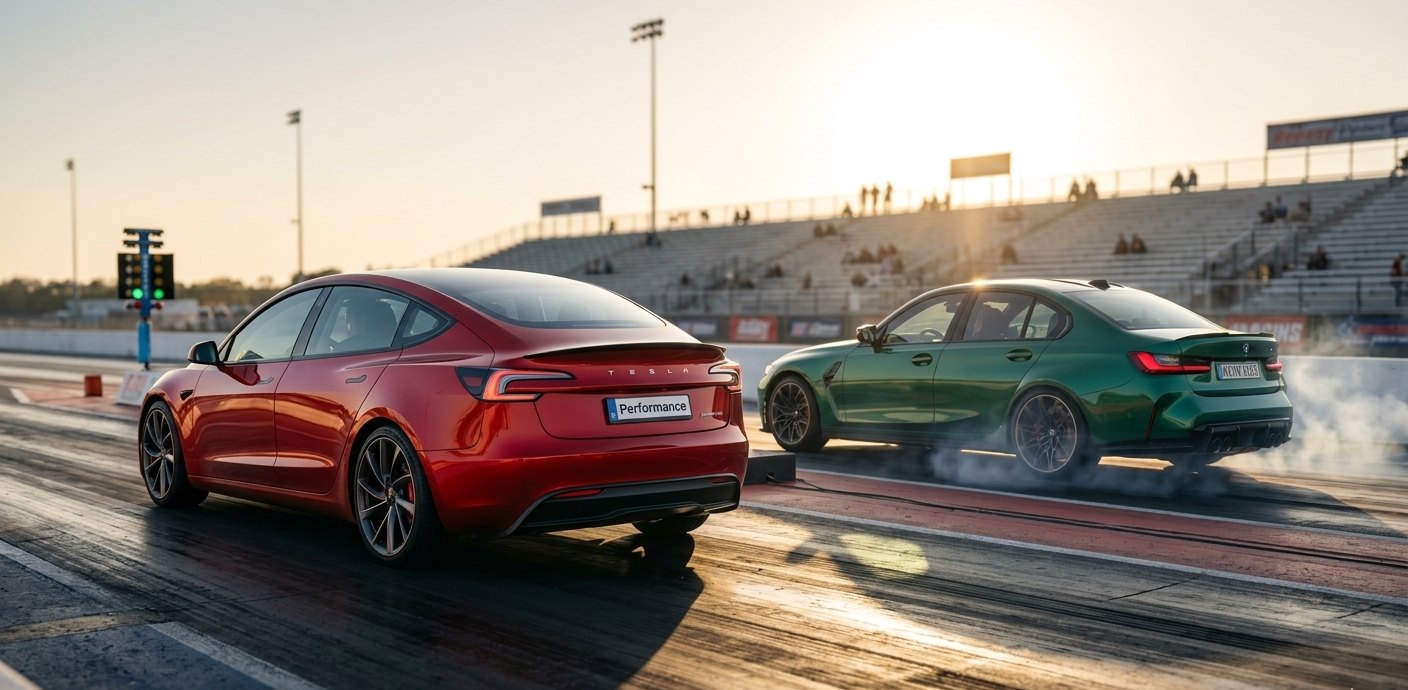
The rivalry between the Tesla Model 3 Performance and the BMW M3 is the definitive “New Guard vs. Old Guard” battle of the 2020s. In 2026, with the arrival of the Model 3 Highland Performance and the refreshed BMW M3 Competition (LCI), the gap has narrowed in some areas while widening in others.
If you want to know which one wins the “Stoplight Grand Prix” and which one owns the racetrack, here is the data-backed truth.
1. Straight-Line Acceleration: The 0-60 Battle
In a pure sprint from a standstill, the Tesla Model 3 Performance remains the undisputed champion for daily driving scenarios.
-
Tesla Model 3 Performance (2026): 2.9 seconds (0-60 mph)
-
BMW M3 Competition xDrive (2026): 2.8 – 3.4 seconds (0-60 mph)
The Reality Check: While the BMW M3 Competition xDrive can clock a 2.8-second run under perfect conditions with Launch Control engaged, the Tesla delivers its 2.9-second thrust instantly, every single time, without the need for complex launch procedures or warm tires.
2. The Quarter-Mile and Top End
As the speeds climb above 100 mph, the mechanical soul of the BMW begins to push back.
-
Quarter-Mile: Both cars are now neck-and-neck, typically crossing the line in the 11.0 to 11.2-second range.
-
Top Speed: The BMW M3 takes the crown here. Equipped with the M Driver’s Package, the BMW hits 180 mph, whereas the Model 3 Performance is electronically limited to 163 mph.
3. Track Performance and Endurance
This is where the 2026 updates matter most. Historically, Teslas struggled with brake fade and battery overheating during extended track sessions.
-
Tesla’s New Hardware: The 2026 Model 3 Performance features Endurance Mode and upgraded high-performance brake pads. It can now handle multiple “hot laps” without significant power throttling.
-
The BMW Edge: Despite Tesla’s progress, the BMW M3 remains the more “precise” instrument. Its S58 twin-turbo engine and 8-speed automatic transmission provide a visceral, mechanical engagement that an EV cannot mimic. On technical tracks with many corners, the BMW’s weight distribution often yields a slightly faster lap time.
4. Price vs. Performance (The $30,000 Question)
In 2026, the “value” argument is almost one-sided:
-
Tesla Model 3 Performance: Starts around $55,000.
-
BMW M3 Competition xDrive: Starts around $88,000.
You are essentially paying a $33,000 premium for the BMW’s badge, exhaust note, and superior interior materials. For many, that is a price worth paying for “soul.” For others, the Tesla’s supercar speed for the price of a mid-size SUV is unbeatable.
FAQs: Tesla vs. BMW Performance
Q: Can the Tesla Model 3 Performance beat a BMW M3 in a rain race?
A: Yes. Tesla’s dual-motor All-Wheel Drive system manages torque at the millisecond level, making it significantly more stable and faster on wet or slippery pavement than the BMW.
Q: Does the BMW M3 have better resale value?
A: Historically, yes. High-performance M-cars tend to hold their value better as enthusiast items, whereas Teslas are treated more like consumer electronics that depreciate as newer battery tech arrives.
Q: Which car is better for a daily driver?
A: The Tesla wins on “refinement” and cost. With no oil changes, lower fuel costs, and a silent cabin, it is the superior commuter. The BMW is the superior “weekend” car.

Leave a Reply