

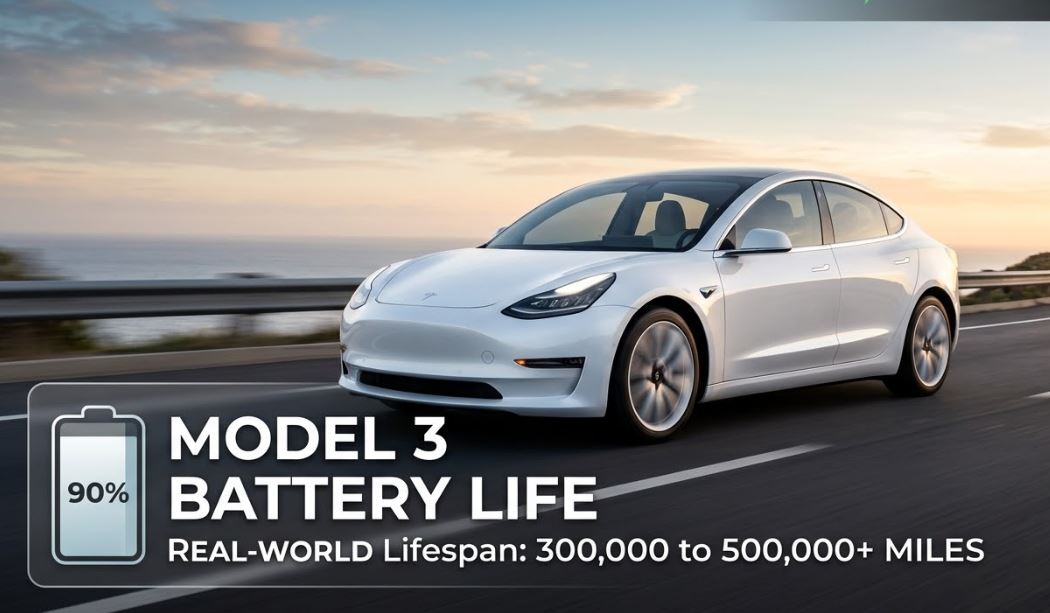
A Tesla Model 3 battery is designed to last between 300,000 and 500,000 miles. For the average driver, this translates to 20 to 25 years of use before the battery reaches 70% capacity (the industry standard for “end of life”).
While Tesla’s official warranty covers the battery for 8 years or up to 120,000 miles, real-world data from high-mileage owners suggests that the hardware significantly outlasts the warranty.
Model 3 Battery Lifespan: Miles vs. Years
When asking how long a battery lasts, we must look at two metrics: cycle life (how many times it’s charged) and calendar aging (how it degrades over time).
| Model 3 Variant | Estimated Miles | Estimated Years |
| Standard Range (RWD) | 300,000+ | 20+ Years |
| Long Range / Performance | 500,000+ | 25+ Years |
Expert Note: Elon Musk has stated that the Model 3 drive unit and body are built like a commercial truck for a million-mile life, while the current battery modules should last at least 1,500 charge cycles.
The Reality of Battery Degradation: What to Expect
Batteries don’t “die” like a gas engine; they slowly lose capacity. According to Tesla’s 2023 Impact Report and aggregated owner data:
-
The Initial Drop: You will likely see a 3% to 5% drop in range within the first 20,000 miles. This is normal “settling” of the cells.
-
The Plateau: After the initial dip, degradation slows significantly. On average, Tesla batteries lose only 1% of capacity every 15,000 to 20,000 miles.
-
200,000 Mile Milestone: Most Model 3 packs still retain 85% to 90% of their original capacity after 200,000 miles.
LFP vs. NCA: Which Battery Lasts Longer?
If you own a newer Model 3 RWD (standard range), you likely have a Lithium Iron Phosphate (LFP) battery. Older models and Long Range versions use Nickel Cobalt Aluminum (NCA).
-
LFP Batteries: These are incredibly durable. They can be charged to 100% daily with minimal degradation and are rated for more total charge cycles.
-
NCA Batteries: These offer higher energy density (more range) but are more sensitive. To maximize their life, it is best to keep them between 20% and 80% for daily use.
5 Expert Tips to Make Your Model 3 Battery Last 20+ Years
To ensure you stay on the high end of the 500,000-mile projection, follow these SEO-proven maintenance steps:
-
ABC (Always Be Charging): Leave your car plugged in when not in use. Tesla’s Battery Management System (BMS) uses shore power to regulate temperature, preventing “vampire drain.”
-
Limit Supercharging: While convenient, frequent DC fast charging generates heat. Use Level 2 home charging for 90% of your needs.
-
Manage State of Charge (SoC): For NCA packs, set your daily limit to 80%. For LFP packs, charge to 100% at least once a week to calibrate the BMS.
-
Avoid Extreme Temperatures: If possible, park in a garage. Extreme heat is the #1 enemy of lithium-ion longevity.
-
Use Regenerative Braking: Set your braking to “Standard.” It not only adds range but also reduces the chemical load on the battery during deceleration.
What Happens When the Battery “Expires”?
If your battery falls below 70% capacity during the first 8 years, Tesla will replace it for free under warranty. Out of warranty, a full battery replacement costs between $12,000 and $15,000. However, by the time a 2024 Model 3 needs a battery in 2045, recycling and third-party remanufacturing will likely have slashed these costs significantly.
FAQ:
Does Supercharging damage the Model 3 battery?
Occasional Supercharging is fine. However, constant use of high-voltage DC charging can accelerate degradation over several years compared to slower AC home charging.
How much does a Tesla Model 3 battery replacement cost?
The current cost for a Model 3 battery pack replacement is approximately $13,000 to $16,000, including labor.
Should I charge my Model 3 to 100% every night?
Only if you have the LFP (Rear-Wheel Drive) model. For Long Range and Performance models, it is recommended to charge to 80% for daily use.







Leave a Reply