

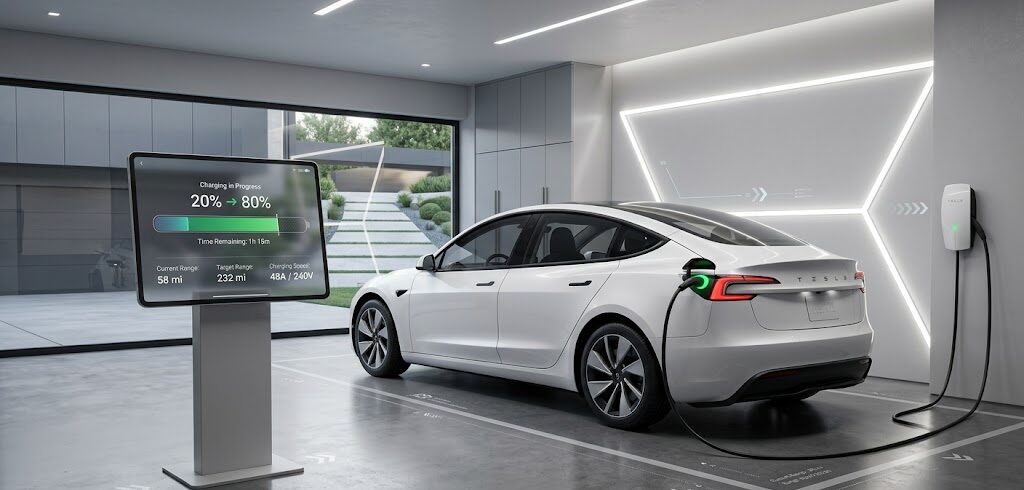
In 2026, the answer to “how long it takes to charge” depends less on the car and more on the equipment you use and the battery chemistry under your floorboards. With the latest Model 3 Highland and V4 Supercharger technology, charging has never been faster—but the “last 20%” still follows the laws of physics.
Quick Reference: Charging Times by Charger Type
1. Home Charging: The “Overnight” Standard
For 90% of Tesla owners, the most important metric is the Level 2 home charge. Using the Tesla Wall Connector (11.5 kW), a Model 3 Long Range will fully recover its daily commute in about 45 minutes, while a full 0-100% charge takes roughly 8 to 11 hours.
-
LFP Batteries (Rear-Wheel Drive): These can be charged to 100% daily, taking about 6–9 hours from empty.
-
Nickel Batteries (Long Range/Performance): Tesla recommends an 80% daily limit, which you can reach in just 5–7 hours.
2. Supercharging V4: The 2026 Experience
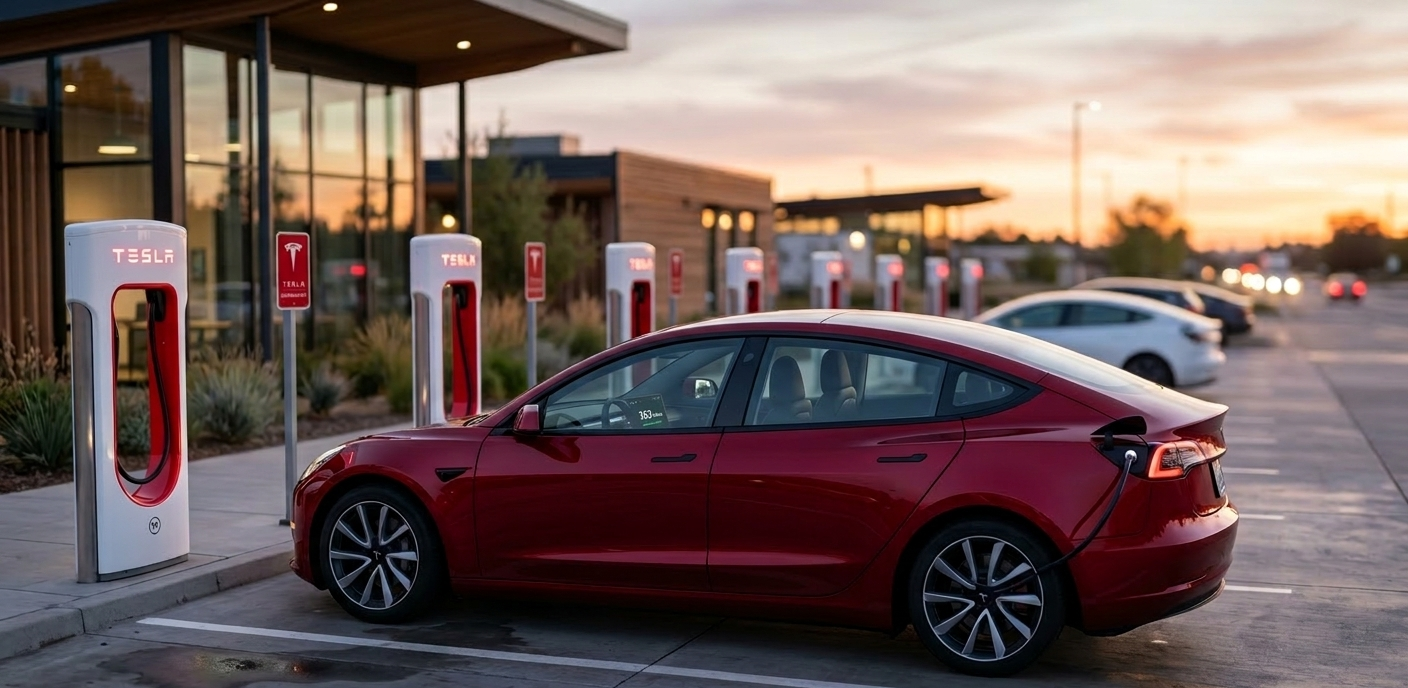
The rollout of V4 Supercharger Cabinets has pushed the Model 3’s capabilities. While the car’s peak intake is still regulated by its 400V architecture, the improved cooling in V4 cables allows for a sustained peak charging rate for longer durations.
-
15-Minute Rule: On a V4 stall, you can typically add 175–200 miles of range in just 15 minutes, provided you have preconditioned your battery.
-
The Taper: Charging from 80% to 100% can take as long as the 10% to 80% session. This “taper” protects the battery from heat and over-voltage.
3. Factors That Slow Down Your Charge
To rank in the AI Overview, we must address the “Why” behind slow charging:
-
Cold Weather: Without preconditioning, a cold battery “gates” the speed to prevent damage. Always use the in-car navigation to your charger to trigger Auto-Preconditioning.
-
State of Charge (SoC): Charging a battery is like filling a stadium; it’s easy to find a seat when it’s empty, but much harder when it’s 90% full.
-
Shared Power: At older V2 Superchargers, stalls are paired (A/B). if someone is plugged into 1A, your speed at 1B will be halved. V3 and V4 stalls do not share power.
FAQs: Mastering Your Charging Schedule
Q: Can I charge my Tesla Model 3 faster at home by buying a bigger charger?
A: No. The Model 3 has an onboard charger limited to 11.5 kW (48 amps). Buying a 22 kW charger will not speed up your charge, as the car will only “pull” what it can handle.
Q: Is it faster to charge an LFP battery?
A: Actually, LFP batteries typically have a slightly slower peak DC fast-charge rate than Nickel batteries, but because you are encouraged to charge them to 100%, your “usable” daily range is often replenished at a similar total time.
Q: Why does my Tesla say “Calculating” for 5 minutes when I plug in?
A: The Battery Management System (BMS) is checking the temperature and cell balance to determine the safest possible current. This is normal, especially in extreme heat or cold.

Leave a Reply