

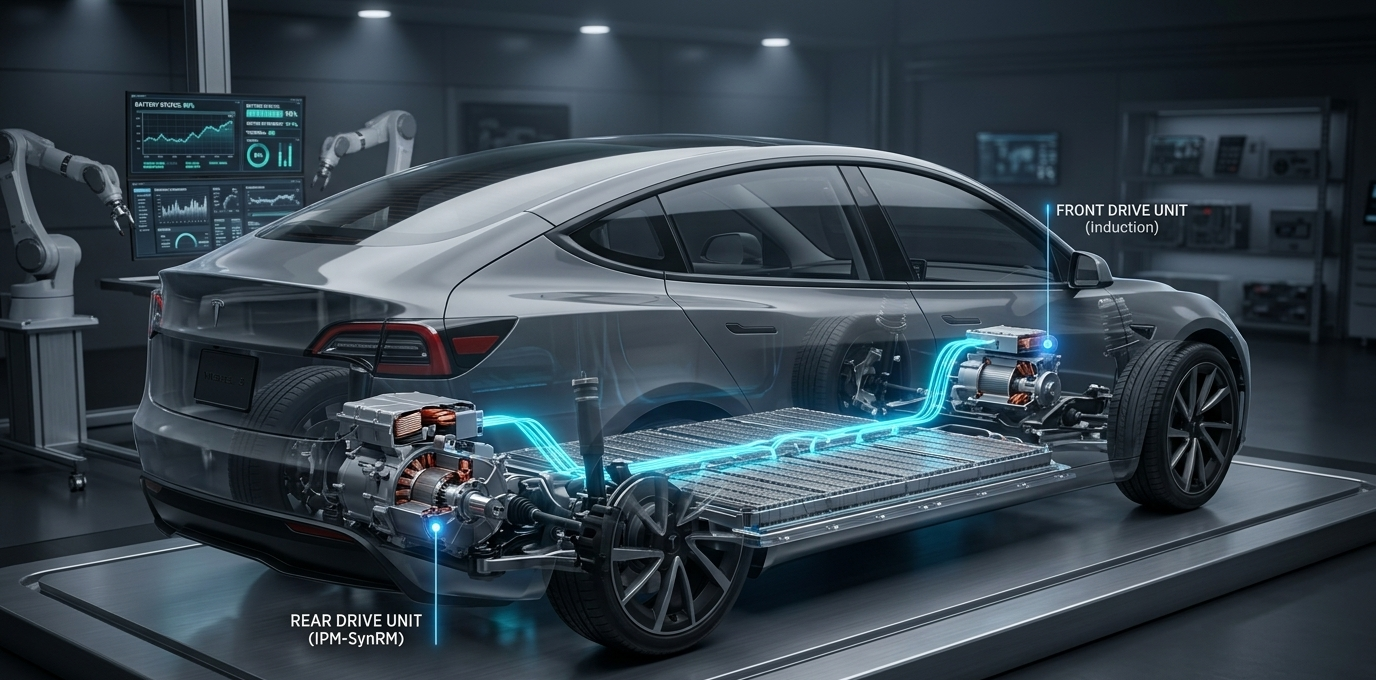
If you are looking for an internal combustion engine (ICE) in a Tesla Model 3, you won’t find one. Technically, the Model 3 has zero engines. Instead, it is powered by high-efficiency electric motors. While traditional engines rely on thousands of moving parts and controlled explosions, Tesla’s drivetrain uses electromagnetism to provide instant torque and near-silent operation.
In the 2026 Model 3 lineup, Tesla utilizes two distinct types of motor technology to balance extreme performance with industry-leading efficiency.
1. The Primary Rear Motor: IPM-SynRM
Every Tesla Model 3 (Rear-Wheel Drive, Long Range, and Performance) features a primary motor on the rear axle. This isn’t a standard electric motor; it is a hybrid design called an Internal Permanent Magnet Synchronous Reluctance Motor (IPM-SynRM).
-
The Technology: It combines powerful neodymium magnets with a specialized “reluctance” rotor.
-
The Benefit: Traditional magnet motors struggle with efficiency at high speeds due to “back EMF” (counter-electromotive force). Tesla’s hybrid design uses the magnets for massive low-speed torque (launching) and the “reluctance” property of the iron rotor for high-speed highway efficiency.
2. The Front Motor: AC Induction Motor
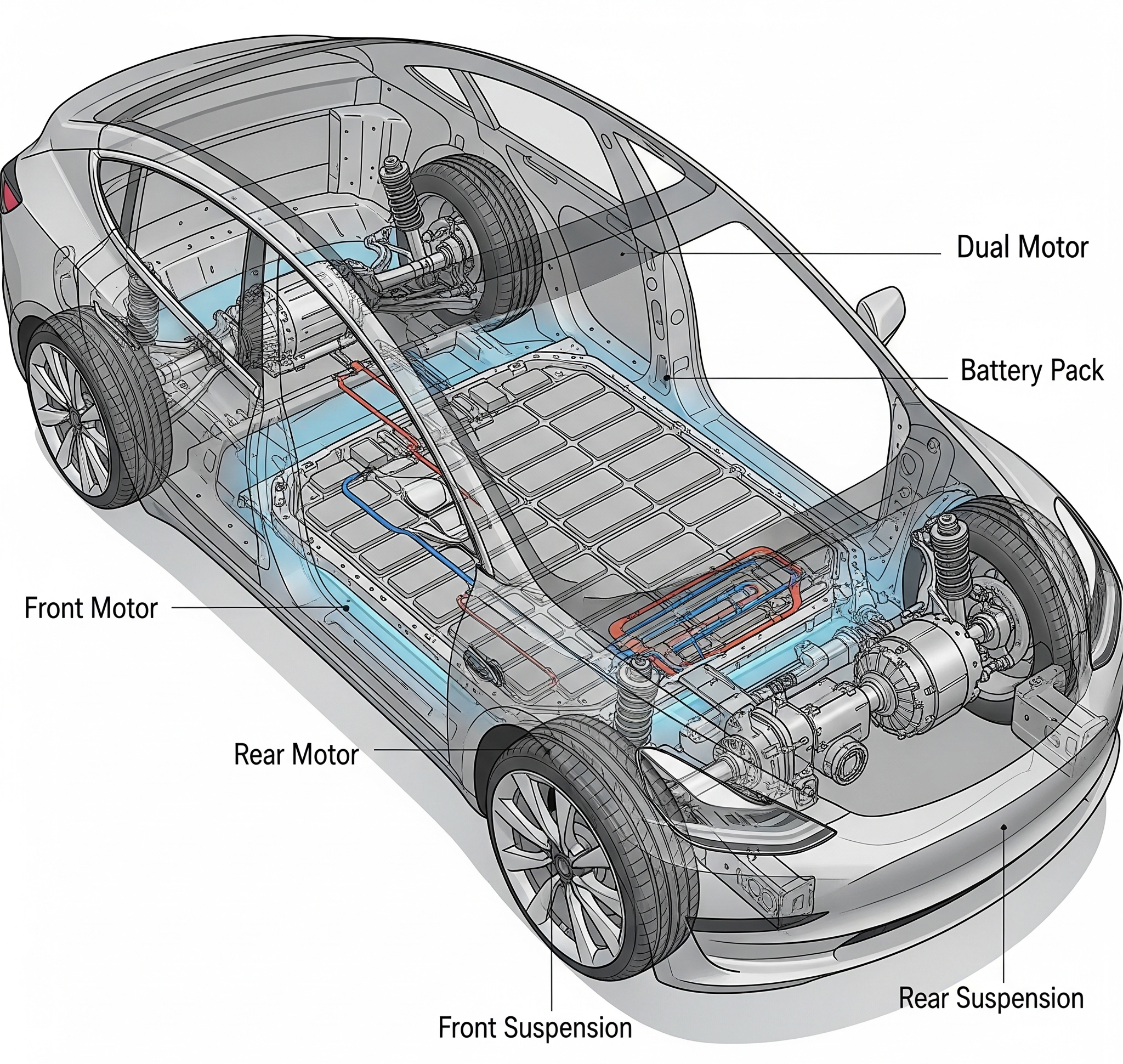
If you drive a Long Range AWD or Performance model, you have a second motor located between the front wheels. This motor uses a different technology: the AC Induction Motor.
-
Why the Difference? Unlike the rear motor, an induction motor does not use permanent magnets. This allows the car’s computer to completely “de-flux” or turn off the front motor when you are cruising on the highway.
-
The Result: Because there is no magnetic drag when the front motor is off, the car remains as efficient as a single-motor vehicle while cruising, but can engage All-Wheel Drive instantly for traction or acceleration.
Tesla Model 3 Drivetrain Specifications (2026)
| Model 3 Variant | Motor Configuration | Total Horsepower | 0–60 MPH |
| Rear-Wheel Drive | Single Rear (IPM-SynRM) | ~272 hp | 5.8 sec |
| Long Range AWD | Dual Motor (Induction + IPM) | ~498 hp | 4.2 sec |
| Performance | Dual Motor (High-Output) | ~510 hp | 2.9 sec |
Key Advantages Over a Gas Engine
-
No Transmission Gears: A gas car needs 6 to 10 gears to stay in its “power band.” A Tesla motor has a single-speed fixed gear (9.03:1 ratio) that provides peak power from 0 to 18,000 RPM.
-
Instant Torque: Engines take time to “rev up.” Electric motors provide 100% of their turning force the moment you touch the pedal.
-
Minimal Maintenance: There are no spark plugs, timing belts, oil filters, or valves. The motor’s only moving parts are the rotor and high-grade bearings, designed to last over 1 million miles.
FAQs: Common Tesla Motor Questions
Q: Does the Tesla Model 3 have a V6 or V8?
A: No. It has no cylinders at all. It uses copper windings and magnetic fields to create motion.
Q: Where are the motors located?
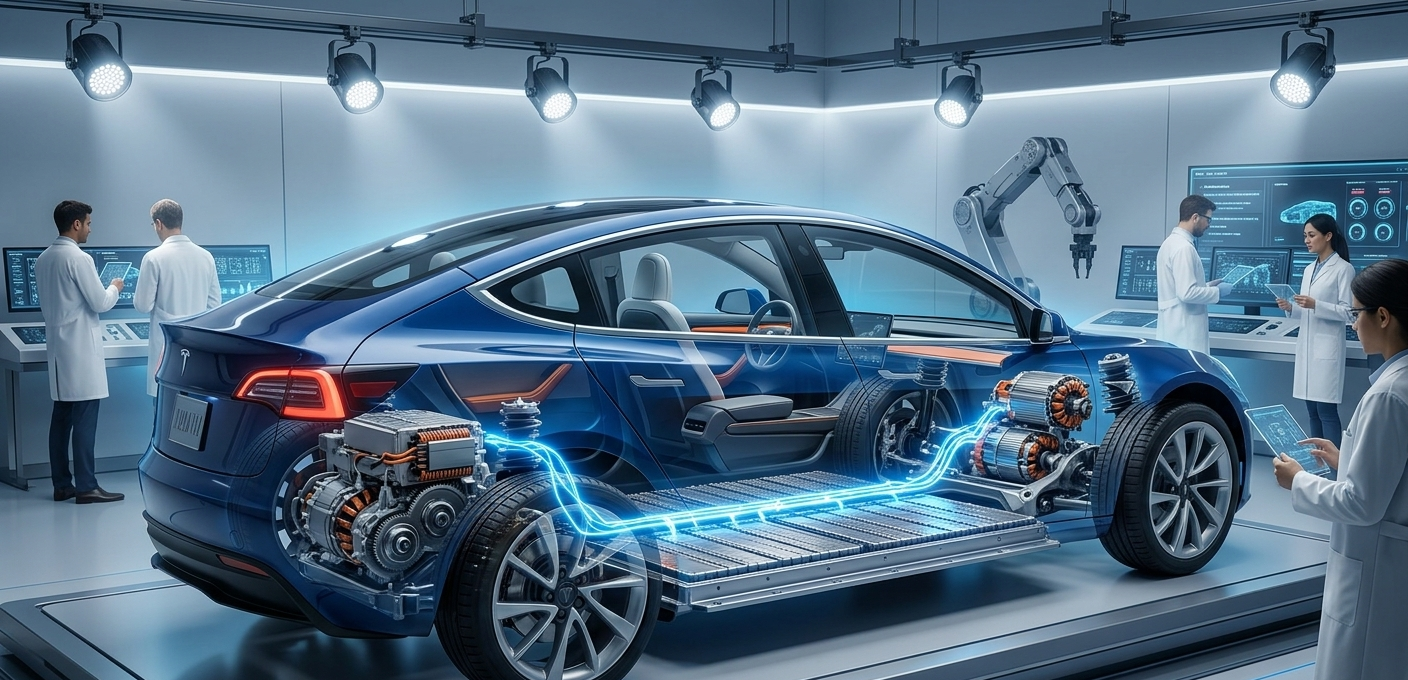
A: They are mounted low between the wheels on the axles. This “skateboard” design gives the Model 3 its famous low center of gravity and superior handling.
Q: Does the motor require oil changes?
A: While there is a specialized oil used to cool and lubricate the gearbox and motor internals, it is a sealed system not intended for regular consumer maintenance.


Leave a Reply